
If you’ve ever set foot in a casino, played online, or watched a film set in a casino, you’ve probably heard both “Blackjack” and “21” mentioned. But are they the same game, or do subtle differences matter when you sit down at a table?
The terms are closely linked, yet the modern casino version called blackjack has added rules and conventions that distinguish it from the older, simpler 21. Read on to see how the two relate, where they diverge, and which might suit you best.
Whether you’re curious about history, rules, or what to expect at a casino table, this guide will give you clear, practical detail without getting bogged down in jargon.
What Is 21? Understanding the Classic Game
21 is a straightforward card game whose basic aim is to get as close to 21 as possible without exceeding it. Players receive cards from a standard deck and total their values: numbered cards count at face value, face cards count as 10, and aces can be either 1 or 11 depending on which suits the hand.
Traditionally, players focused on their own hands rather than on strict dealer-play structures. If a hand’s total went above 21, that hand was bust and lost for that round. The simplicity of 21 made it popular in private games and clubs long before the casino-style version emerged.
The game has deep roots in Europe, with French and Spanish variants recorded from the 17th and 18th centuries. These early versions shared the same core principle—reach 21 or as near as possible—but rules and table procedures varied by region and by the preferences of the players. That straightforward foundation is what later developed into the modern game we know as blackjack.
What Is Blackjack? Key Rules and Features
Blackjack evolved from classic 21 but formalised the play into a consistent casino format. In this version, each player competes against the dealer rather than against other players. Both dealer and player receive two cards at the start, typically with the player’s cards visible and the dealer showing one card.
Blackjack introduces several tactical options. Players can request another card to improve their total, or stand and keep their current total. They may be allowed to double their stake in return for one additional card, and pairs can sometimes be split into separate hands for additional wagers. These options create more decisions each round and shift some emphasis toward strategy and bankroll management.
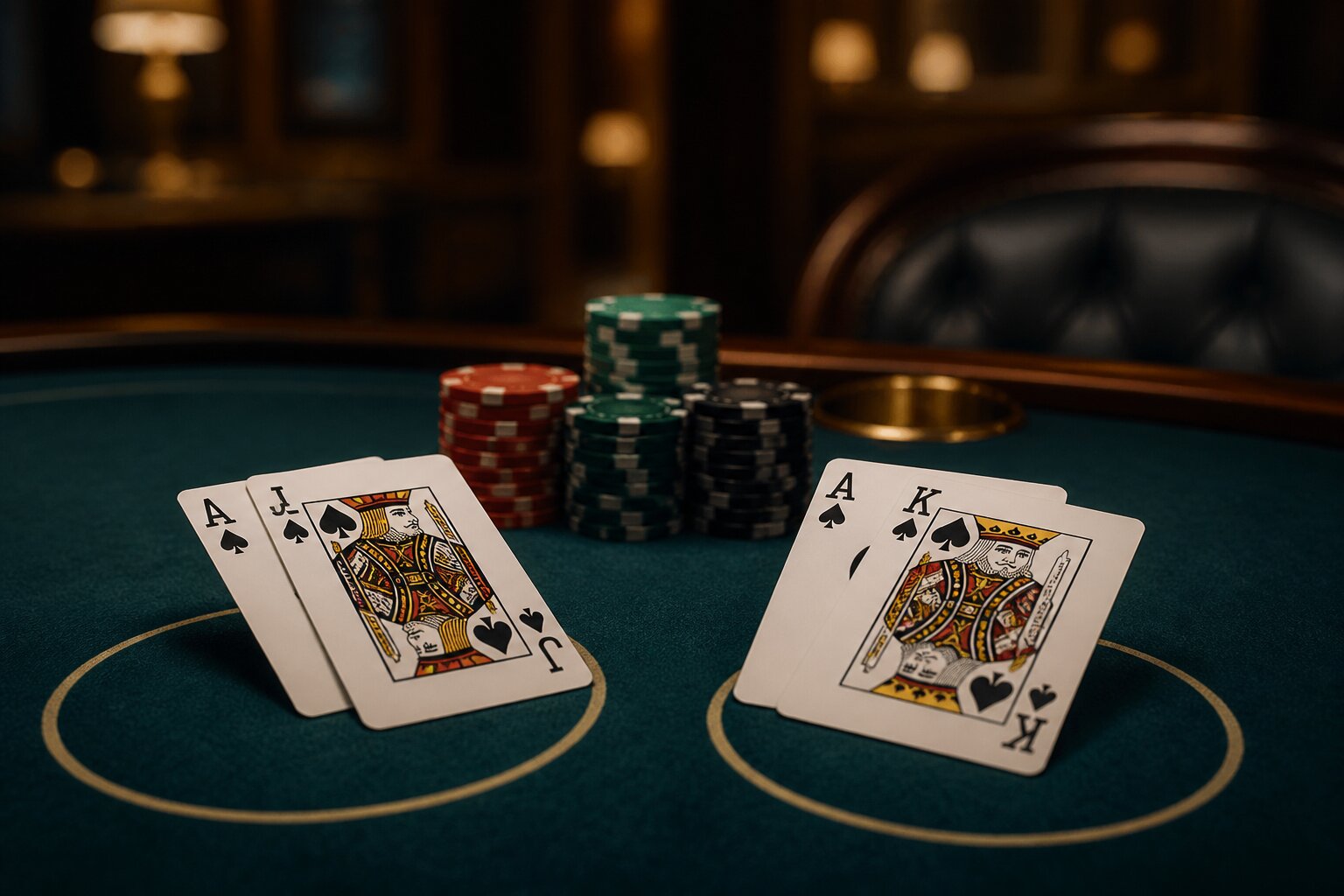
A two-card hand of an ace plus a 10-value card is known as blackjack, and most casino rules attach a higher payout to that initial combination. Those specific payout terms vary by venue, but the status of that hand as the strongest remains consistent.
How Are Blackjack and 21 Different?
Although blackjack and 21 share the same objective, their differences lie in structure and additional options. Blackjack standardises dealer behaviour, betting mechanics, and player choices, creating a uniform experience across tables. Classic 21 tends to be looser in format and can change with house or home rules.
Where the games most noticeably differ is in the availability of actions such as doubling down and splitting pairs, and in how certain hands are rewarded. Blackjack’s rules tend to create a clearer framework for when to make each decision, whereas 21’s simpler format leaves more scope for informal or local variations.
These distinctions affect how a session feels at the table: blackjack presents a consistent set of expectations, while 21 can feel more like a flexible social game that adapts to the setting.
Card Values and Scoring Explained
Both games use the same card values: numbered cards equal their number, face cards count as 10, and aces can be 1 or 11. The key scoring difference lies in how a two-card ace plus 10-value card is treated. In blackjack, that combination usually has priority and a special payout when dealt as the opening hand. In classic 21, reaching a total of 21 is the goal, but there is not necessarily a standard premium for the ace-plus-10 combination.
This difference matters because the payout structure influences expected returns and the strategic choices players make during a hand.
Gameplay and Rules Comparison
Gameplay in 21 can vary from being informal, with players sometimes taking turns as dealer, to being slightly organised in card clubs. Blackjack, by contrast, locks in a fixed dealer role, a standard sequence of play, and commonly accepted house rules. Blackjack also frequently offers side bets and insurance options not typically found in classic 21.
These additional features create more pathways for decision-making and a more predictable environment for players who prefer consistency.
Origins of Blackjack and 21: A Quick Overview
The story begins in Europe, where games with the twenty-one objective appeared in France, Spain, and Italy several centuries ago. The French game vingt-et-un was particularly influential. As the game travelled and adapted, different houses and regions added their own quirks.
When the game arrived in North America, some establishments introduced bonus payouts to attract players. One historical bonus for a hand including the ace of spades and a black jack gave rise to the name blackjack. Over time, as casinos standardised rules to suit regulated play and house economics, the version labelled blackjack took shape and became the mainstream, widely available game.
Tracing this history shows how small incentives and local preferences can transform a simple pastime into a formalised casino staple.
Is One Game More Popular Than the Other?
In contemporary casinos and online platforms, blackjack is the dominant form you will encounter. Its standardised rules and predictable structure have made it the preferred offering for commercial venues and regulated sites. Classic 21 survives mainly in informal settings or among players who prefer a simpler, less regimented format.
If you visit a casino floor or browse gaming options online, you are far more likely to find multiple blackjack tables and variations of that game than a table labelled simply as 21. That prevalence reflects the industry’s preference for a set of rules that can be applied consistently across many locations.
Can You Play Both Blackjack and 21 in UK Casinos?
Most licensed operators in the UK offer blackjack rather than a separate classic 21. Blackjack’s rules are well-defined and align with regulatory expectations, which helps ensure transparency and fairness for players. The version you find in casinos and on regulated online sites will generally follow those standard rules, including clear house rules, payout structures and, where applicable, live-dealer procedures.
If you play online, many operators provide both electronic table versions and live-dealer blackjack, but they are still branded and operated as blackjack rather than a distinct “21” product. Before you play, check the terms and conditions, game rules and any specific house variations so you know how a particular table or product works.
The legal gambling age in the UK is 18, and play should take place at properly regulated venues or platforms. Licensed operators will carry out identity checks and enforce age restrictions to meet UK Gambling Commission requirements.
If you prefer a more informal game, classic 21 is more likely to appear in private games among friends than on a casino floor. Those private games can vary widely in rules and stakes, so agree the rules and limits up front and ensure everyone is playing responsibly.
Common Myths About Blackjack and 21
Several misunderstandings persist about these games. One is that blackjack and 21 are entirely different games; in truth, blackjack is a refined, casino-ready form of 21. Another myth is that past outcomes influence future ones; each deal is resolved independently according to the rules and the cards in play, so prior hands do not determine later results.
People also sometimes overestimate the role of skill. Knowing strategy and the rules improves decision-making, but there are no guarantees of winning. Finally, age and licensing matter: only adults may play in licensed venues, and sites should be properly regulated.
Clearing up these points helps set realistic expectations before you play.
Which Game Should You Choose? Factors to Consider
Choosing between blackjack and classic 21 comes down to what you want from the session. Blackjack appeals if you value a structured environment with clearly defined options and common house rules. Its built-in choices, such as doubling and splitting, create moments where knowledge and judgement affect outcomes.
If you prefer a simpler, more flexible social game, classic 21 may suit informal play among friends, though it is less likely to be offered commercially. Availability is also a practical factor because blackjack is almost always the version provided in casinos and online.
Think about what makes the experience enjoyable for you, and play within the established rules and your personal limits. If gambling ever feels problematic, support services exist to help, and taking a break is a constructive step.
This should leave you well placed to recognise the differences and pick the version that fits how you like to play.
**The information provided in this blog is intended for educational purposes and should not be construed as betting advice or a guarantee of success. Always gamble responsibly.