
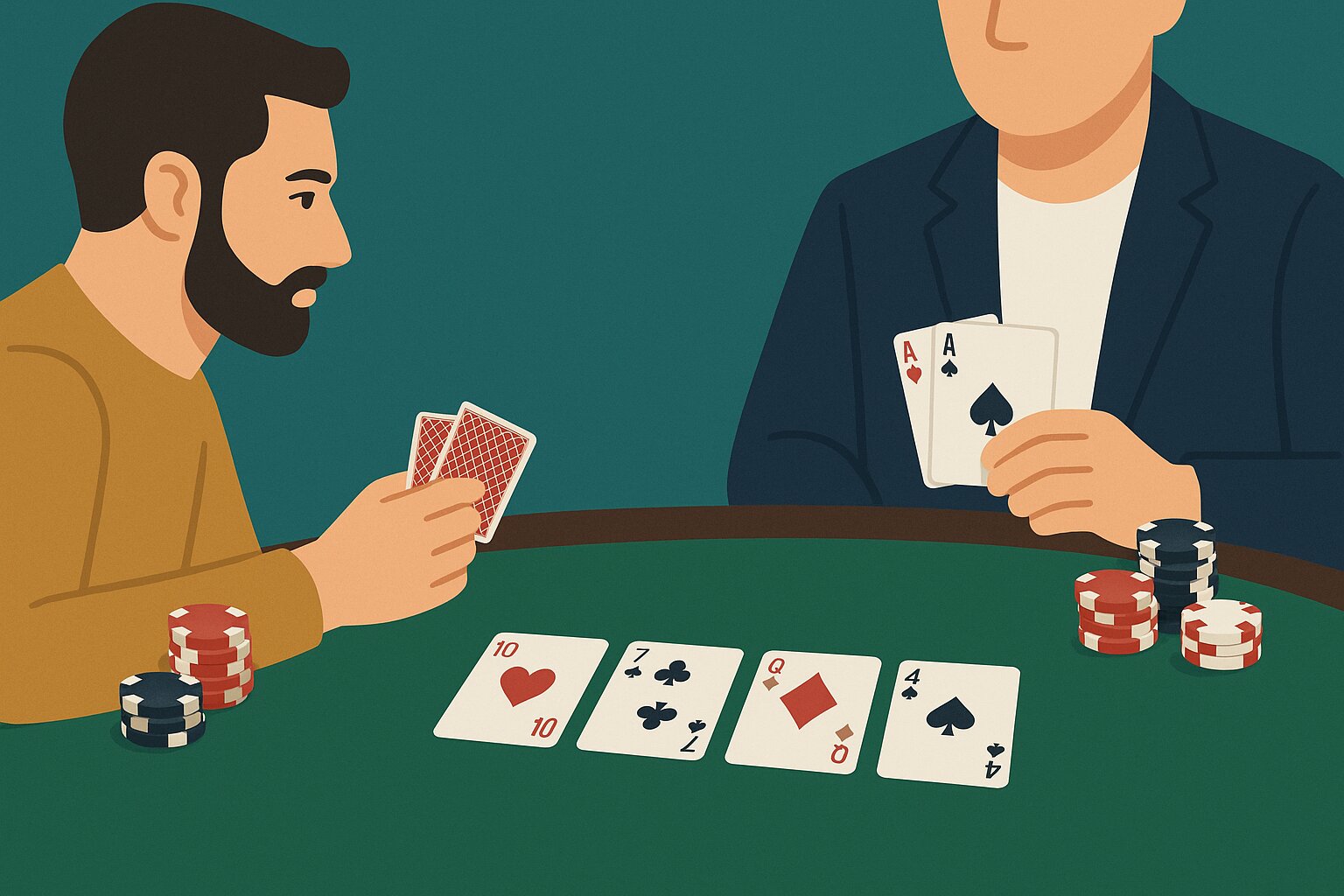
Looking to sharpen your poker skills for tense one-on-one games? Heads up poker is a concentrated, strategic form of the game where every decision matters and the action rarely slows.
This guide walks through the rules that matter in heads up play, explains how it differs from full-table games, and offers practical tips to help you make smarter choices at the table. Keep in mind basic safeguards like setting time and money limits before you start so your sessions stay controlled and enjoyable.
Read on to get a clear, confident handle on heads up poker and what to expect when you sit down opposite a single opponent.
What Is Heads Up Poker?
Heads up poker is the two-player form of poker in which each hand is contested directly between just two people. You still use the familiar sequence of dealing private cards, revealing community cards, and comparing final hands, but the environment and priorities change because there are only two participants.
This format appears in both cash games and tournament finales. Fewer players means faster hands and more frequent engagement; you will act in every deal and must adapt quickly to your opponent’s style. Strategy shifts here are pragmatic: with fewer unknowns at the table, reading tendencies and exploiting positional advantages become central to success.
Understanding these differences is the first step to playing the format well, so keep these points in mind as you move into the specific rules and nuances that follow.
How Do Heads Up Poker Rules Differ From Regular Poker?
At its core, heads up poker follows the same fundamental rules as other poker variants, yet a few important adjustments alter how the game flows.
The most noticeable change is how the blinds and dealer button operate. In heads up, the dealer posts the small blind and the other player posts the big blind. Pre-flop action begins with the dealer, but after the flop the dealer acts last for the remainder of the hand. These position shifts affect betting dynamics and the value of acting last on later streets.
Because you are involved in every hand, the tempo is quicker and hands resolve more often. That means marginal decisions and bluffing play out differently than they would at a larger table, with more opportunity to pressure a single opponent. Before you play, check any house rules that might adjust bet sizes or time controls so there are no surprises.
If you want to get better, pay attention to how these small rule changes reshape common choices at the table.
Essential Heads Up Poker Rules Explained
A few core rules keep heads up poker fair and straightforward.
Each hand begins with two blinds: the small blind, posted by the dealer, and the big blind, posted by the other player. Pre-flop, the dealer acts first; on the flop, turn and river the dealer has the advantage of acting last. Both players receive hole cards and use community cards to form their best five-card hand, with standard hand rankings applying.
Betting proceeds through pre-flop, flop, turn and river rounds, and if both players remain at the end there is a showdown to determine the winner. Roles rotate after each hand so both players alternate posting the blinds and holding the dealer button over time.
Knowing this order of play and the rotation of positions is essential to avoid procedural mistakes and to understand when to apply pressure or exercise caution.
Key Differences Between Heads Up and Full-Ring Games
The contrast between heads up and full-ring poker shows up in several practical ways.
With only two players, you will see and act in every hand; there is no waiting for your turn to come around. This increases the frequency of hands you must evaluate and makes short-term adjustments more rewarding. Table position matters differently: acting last after the flop is a bigger advantage one-on-one than it is at a table with many players.
Strategically, you face a single profile rather than multiple opponents with varied tendencies. That simplifies some decision-making but raises the importance of reading your opponent’s habits and adapting quickly. Also, the rotation of blinds is faster, so equity swings and variance can feel sharper.
These differences affect both the pace of play and the types of lines that work best, which is why players often prefer one format over the other depending on their comfort with constant engagement.
Turn Order & Dealer Position: What Changes in Heads Up Play?
Turn order and the dealer position in heads up play are compact but influential elements of the game.
The dealer posts the small blind and acts first pre-flop, which is the only time they do not have last action. After the flop the dealer gains the advantage of acting last for the remainder of the hand, and that last-action privilege can be decisive when choosing whether to bet, call or fold on later streets.
Positions rotate after each hand to keep things fair; both players will take turns being the dealer and posting each blind. Understanding when you will act first or last helps you plan broader strategies, such as when to apply pressure or when to exercise caution with marginal hands.
These positional nuances shape the ebb and flow of heads up play, so keeping them in mind will improve your decision-making.
How Many Players Can Play Heads Up Poker?
By definition, heads up poker is for exactly two players. The format is designed for one-on-one competition and does not accommodate more participants. This makes the game faster and often more aggressive than multi-player tables, since each player faces the same opponent on every hand.
You should also be aware of legal age requirements. Under UK law, only those aged 18 and over may participate in regulated poker games. Operators will usually require valid identification and may carry out age verification checks to ensure compliance.
Other practical points to remember include:
- Only two players may be seated for a heads up game at any time.
- Players must meet the minimum legal age of 18 and pass any required ID or verification checks.
- Games should be run in line with the venue or operator's terms and any applicable regulations.
Stick to these participation rules to ensure games run smoothly and within regulatory expectations. Observing the age limit and seating rule helps protect players and keeps the game fair and compliant.
Common Misconceptions About Heads Up Poker Rules
Several misconceptions commonly crop up among players new to heads up play. Clearing them up keeps expectations realistic.
One frequent idea is that heads up is merely a faster version of standard poker. While it is quicker, the shift in blinds, dealer action and the constant presence in every hand change strategic priorities. Another misunderstanding is that special hands or rankings differ in heads up; they do not. Standard hand rankings still decide showdowns.
Finally, some players assume aggressive play always wins heads up. Aggression is a useful tool, but its effectiveness depends on timing, opponent tendencies and pot control. Observant, adaptive play typically outperforms mindless aggression.
Knowing what is and is not different helps you avoid common mistakes and play more effectively from the outset.
What Tips Help Beginners Succeed in Heads Up Poker?
Beginners can make steady progress by focusing on a few practical areas.
Start by getting comfortable with the rule and position changes so you do not make procedural errors. Observe your opponent closely: because you face the same person each hand, patterns emerge quickly and can inform profitable responses.
Manage sessions sensibly by setting clear time and monetary limits before you play. This habit keeps your decisions calmer and your sessions predictable. When deciding whether to bet or fold, weigh the likelihood that your opponent will call or raise, and adapt your approach as their tendencies become clearer.
Finally, embrace gradual improvement. Heads up is a format where small adjustments compound quickly, so aim for consistent, thoughtful changes rather than dramatic shifts in style.
Frequently Asked Questions About Heads Up Poker
Below are common questions and succinct answers to help clarify the format.
Is heads up poker only for two players?
Yes. The structure and rules of heads up are specifically for two participants.
Are the hand rankings different in heads up poker?
No. Hand rankings are the same as in any poker game; the strongest standard hand wins at showdown.
Who posts the blinds in heads up play?
The dealer posts the small blind and the other player posts the big blind for each hand.
Can I play heads up poker if I am under 18?
No. UK regulations require players to be aged 18 or over to take part in regulated poker games.
Are there any special strategies I should use?
Rather than rigid “special” strategies, success comes from tight observation and adapting to one opponent’s tendencies. Managing session limits and playing within them is equally important.
If you want more detailed advice, consult reliable resources and keep your play within sensible boundaries.
**The information provided in this blog is intended for educational purposes and should not be construed as betting advice or a guarantee of success. Always gamble responsibly.