
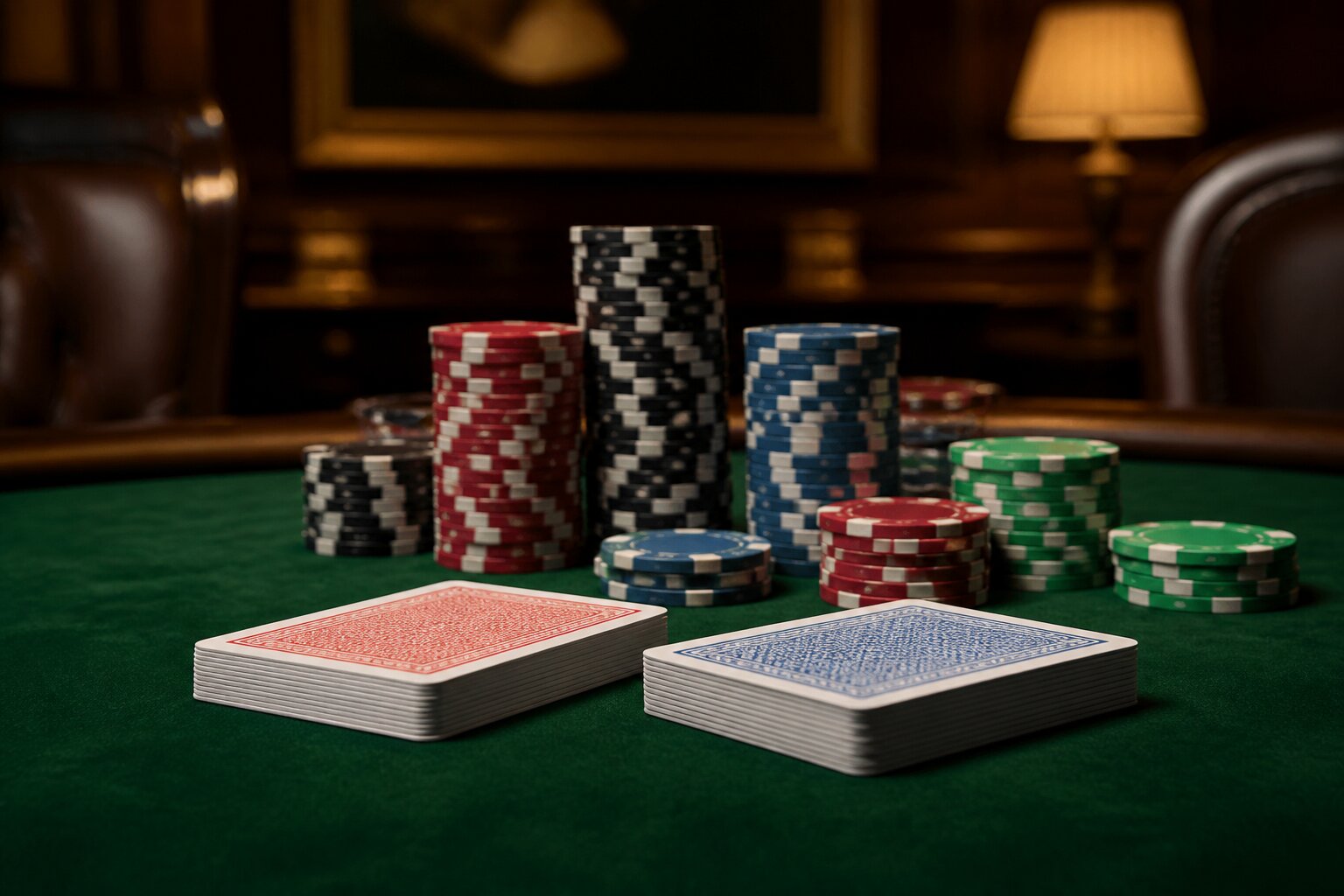
Ever found yourself around a poker table and wondered just how many decks are shuffled into the mix? You’re not alone. Whether you’re a complete beginner or have played a few hands, that question comes up a lot.
Understanding how many decks are used can make a real difference to how comfortable you feel at the table. Different poker variations can have slightly different practices behind the scenes, but the essentials are straightforward.
Curious to learn how it all works? Read on and you’ll soon know what to expect wherever you play.
What Is a Standard Poker Deck?
A standard poker deck contains 52 cards, divided into four suits:
- hearts
- diamonds
- clubs
- spades
Hearts and diamonds are normally red, while clubs and spades are black. Each suit has 13 cards, and the cards within a suit are ranked from lowest to highest.
The ranks are, in order:
- 2, 3, 4, 5, 6, 7, 8, 9, 10
- Jack
- Queen
- King
- Ace
That ranking is used to determine hand strength and combinations across common poker variants. In many games the Ace is high, but in some variants it can be used as the lowest card, for example in a five-high straight.
Most poker games use this standard 52-card set. Jokers or extra cards are rarely included unless a specific variant explicitly requires them, so you can assume a single standard deck unless told otherwise.
Why Do Some Poker Games Use More Than One Deck?
In the vast majority of poker games, only one deck is dealt for each hand. However, you might still see multiple physical decks at the table in certain settings.
Casinos and busy card rooms keep several decks in rotation to speed up play and to replace worn or damaged decks quickly. Having spares means dealers can change decks between hands without interrupting the action for long.
That extra stock of decks is about efficiency and integrity rather than changing how the game is played. Only one deck is active in play for any given hand, and the rules of the game remain the same.
How Many Decks Are Used in Popular Poker Variants?
Most popular poker variants rely on one standard 52-card deck per hand. This applies whether you are at a home game, a club or playing online with a reputable operator. Jokers are generally not used in these variants, unless a house rule or a specific game format explicitly states otherwise.
Dealing procedures can include burn cards and exposed cards, but those are taken from the same single deck in play. In live games the deck is shuffled between hands; online the same single-deck logic is simulated by a certified random number generator.
Texas Hold'em
Texas Hold’em is almost always dealt from a single 52-card deck. Each player receives two private cards and there are five shared community cards on the table, which together form the basis of each hand.
The sequence of dealing and the use of burn cards are standardised, and the single-deck format keeps the probabilities and hand values consistent from hand to hand.
Omaha
Omaha, including both Hi and Hi-Lo, also uses one standard deck. The game structure differs from Hold’em: players receive four private cards and must use exactly two of them together with three of the five community cards to make their final hand.
Despite the different card allocation rules, the deck count and card distribution probabilities are based on the same 52-card pool.
Stud Poker
Variants such as Seven Card Stud and Five Card Stud are played with a single deck as well. These games do not use community cards; instead, players receive a mix of face-up and face-down cards over several betting rounds.
Although the dealing pattern and the presence of exposed cards change the strategy, the number of cards in the deck remains the same.
Casino Poker Games
Casino poker table games use one standard deck for each hand. Examples include:
- Three Card Poker
- Casino Hold’em
- Caribbean Stud
Operators follow set procedures so the game is dealt consistently and transparently, with rules and shuffling methods posted or explained by staff. If you are unsure about a specific table’s practices, it is straightforward to ask the dealer or check the posted rules before you join.
Does the Number of Decks Affect Poker Gameplay?
Because only one deck is used for each hand in standard poker, the probabilities and hand frequencies remain consistent across most games. That uniformity makes strategy and hand-reading transferable between venues and helps players rely on familiar odds when making decisions.
If multiple decks were ever used simultaneously — which is extremely uncommon in poker — it would alter how often particular cards and combinations appear. That would change the math behind drawing odds and the relative strength of hands, so some commonly used heuristics would no longer be accurate. For practical purposes, however, you can plan as though a single deck is in play, since that is the overwhelming norm.
When you join a new game, a quick check of the house rules clears up any doubts and ensures you're playing under familiar conditions. If anything seems unclear, ask the dealer or floor staff before you sit down so there are no surprises during play.
Are There Any Myths About Decks in Poker?
A few myths circulate about decks in poker. One persistent idea is that venues use extra decks secretly to favour the house or alter outcomes. Properly run games don’t do this; game integrity depends on consistent deck usage and transparent procedures.
Another misconception is that online poker rooms use more decks to speed things up or create different results. Reputable online platforms simulate a single standard deck per hand, mirroring live play.
If you ever have concerns about how a game is managed, asking staff for clarification is the best course. Clear rules and visible procedures are signs of a well-run game.
How to Check the Number of Decks Before Playing
It is simple to confirm deck practices before you sit down.
At a venue, ask a member of staff or the dealer how the table operates. There is often a sign or posted rules at the table that states the number of decks, the shuffling method, and any other relevant house practices.
Online, check the game lobby, rules page or help section for deck information. Reputable operators make these details easy to find so players know what to expect before they start a session.
You can also use these quick checks to confirm deck details:
- Ask staff or the dealer in person at land-based venues.
- Look for posted rules at or near the table.
- Read the game description, help pages or rules in the online lobby.
- Contact customer support if the information is not clearly displayed.
Taking a moment to check the rules helps avoid surprises and gives you more confidence when you join a game. If anything is unclear, pause and ask for clarification before you play.
Summary: Choosing the Right Poker Game
Knowing that most poker variants use a single 52-card deck helps you approach new games with confidence. That consistency means rules, probabilities and hand values stay familiar across different settings.
If you’re picking a table, look for clear rules and transparent dealing. Play within your means and set sensible limits so the game remains enjoyable. When you take those simple steps, you’ll get the most from your poker experience.
**The information provided in this blog is intended for educational purposes and should not be construed as betting advice or a guarantee of success. Always gamble responsibly.