
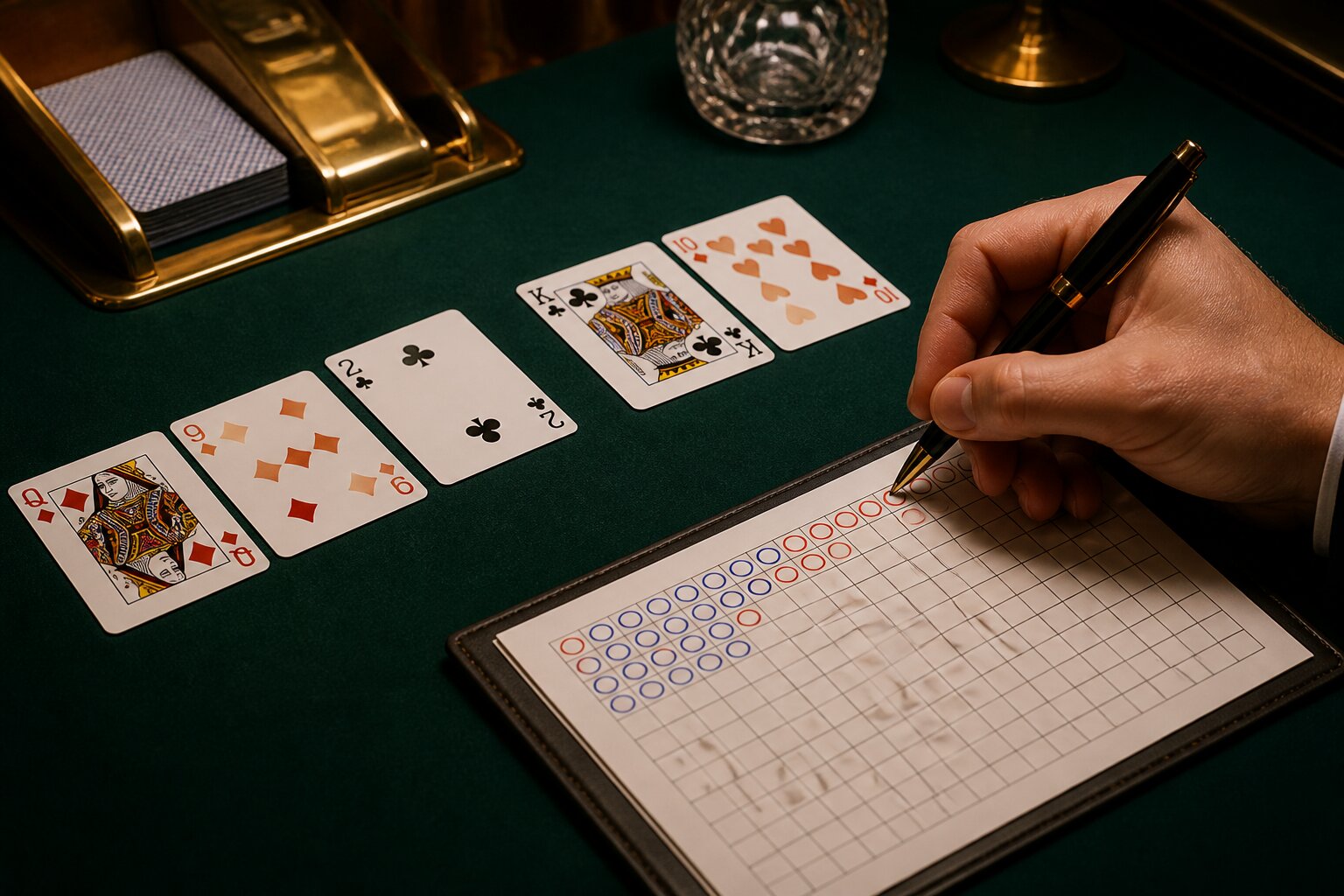
Ever sat at a baccarat table and noticed players methodically marking little grids and cards after each hand? It’s a ritual that adds another layer to the experience—players engage with the action and try to spot patterns in the unfolding sequence of results. While the rules of baccarat are straightforward, the culture of scorekeeping gives the game a social and analytical flavour that many find absorbing.
With rows of red and blue circles and small marks for Ties, those cards can look like a secret language. Understanding what’s being recorded makes the table less mysterious and helps new players follow the flow of play without feeling lost.
If you want to know what the marks mean and how they influence betting behaviour, read on for clear examples of the common scorecards and how they’re used at the table.
Why Do Players Keep Score in Baccarat?
Keeping a record of Player, Banker or Tie outcomes is often about more than trying to predict the next result. For many people it adds involvement, helping them track the rhythm of the shoe and share observations with others at the table. The act of marking results turns a series of quick hands into a narrative—each round becomes a small chapter in the evening’s story.
Players have different reasons for keeping score. Some enjoy spotting long runs or alternating patterns because it gives the session structure. Others use the cards to settle friendly debates or to remember where the shoe left off if they step away briefly. You’ll also see discussions about “streaks” or “choppy” play; these are simply ways to describe what the scorecard is showing.
Next, we’ll look at the actual systems people use to record outcomes so those dots and columns make sense.
Popular Methods for Tracking Outcomes
Scorekeeping in baccarat has settled into a few recognisable formats that make it easy to see recent results at a glance. Casinos commonly provide simple cards or charts so everyone can follow the same visual language. Two of the most familiar systems are the Bead Plate and the Big Road.
What Are Bead Plate and Big Road Scorecards?
The Bead Plate is a straightforward grid. Results are recorded top to bottom, left to right, with a colour or symbol for each outcome. A typical convention is to use a blue mark for Player, a red mark for Banker and a green mark for Tie. After several hands, the grid forms a compact history that is easy to scan.
The Big Road emphasises runs. Instead of filling a grid steadily across, this chart stacks identical outcomes down a column until the result changes, at which point a new column starts. Long columns indicate consecutive wins for one side; alternating columns indicate back-and-forth results. This vertical arrangement makes it simple to spot whether the shoe has gone quiet or is producing extended sequences.
These two charts are complementary: the Bead Plate records every individual outcome in order, while the Big Road highlights streaks and shifts in momentum. A table showing both gives a clear picture of how the shoe has behaved recently.
How Are Trends Marked and Interpreted?
Players develop conventions for marking ties, interruptions and other special cases. For example, a Tie is often noted with a small mark on the most recent result rather than beginning a new entry, so the sequence of Player and Banker outcomes remains obvious. Other notations can include small slashes or dots to indicate shoe changes or note particular hands, but the underlying goal is always the same: create a readable history.
Interpreting these charts varies by player. Some look for long continuous columns in the Big Road as an indication that one side has dominated for a while. Others pay attention to alternating patterns that suggest frequent switching between Player and Banker. These interpretations are used to inform personal wagering choices, though they do not change the underlying probabilities of each round.
The next section shows concrete examples of what these scorecards look like after a series of hands, which makes the previous explanations easier to picture.
What Do Example Baccarat Scorecards Look Like?
A well-kept Bead Plate after ten rounds shows each result in sequence. The visual record might be:
[Blue] (Player)
[Red] (Banker)
[Red] (Banker)
[Blue] (Player)
[Blue] (Player)
[Green] (Tie)
[Red] (Banker)
[Red] (Banker)
[Blue] (Player)
[Red] (Banker)
Each mark corresponds to a single hand, laid out so anyone joining the table can see the recent order.
The same sequence on a Big Road would be arranged by streaks and changes. One possible layout for these ten results:
Column 1: [Blue] [Blue]
Column 2: [Red] [Red] [Red] [Red]
Column 3: [Green]
Column 4: [Blue]
Column 5: [Red]
Here, columns capture runs of identical outcomes, and a Tie is typically denoted without starting a new streak column. Seeing both styles side by side gives a fuller sense of how the shoe has behaved and makes it easier to identify whether play has been dominated by streaks or has been more mixed.
Having seen what the cards look like, the logical question becomes whether those records actually affect what players choose to do next.
Can Scorekeeping Influence Player Decisions?
Scorecards often shape how people place bets, because they give players something concrete to discuss and base decisions on. Some follow streaks and back whatever has been winning; others bet against a run, expecting the outcome to change. There are also hybrid approaches where players combine observations from both the Bead Plate and Big Road before choosing how much to stake.
It’s important to note that while scorecards influence behaviour at the table, they do not alter the statistical properties of baccarat hands. Each round is dealt independently and past outcomes do not determine future ones. With that in mind, scorekeeping functions primarily as a behavioural and social tool: a way to read what has happened and decide how to participate in the session.
Regulatory guidance emphasises that tracking outcomes should not be treated as a method of prediction. Players are encouraged to set limits and manage stakes so play remains enjoyable and controlled.
Now that the effect on decision-making is clear, it helps to examine some common myths that surround scorekeeping.
Are There Common Myths About Baccarat Scoring?
Misconceptions about scorecards are widespread. Separating fact from fiction makes it easier to use scorekeeping as an entertaining aid rather than treating it as something definitive.
Myth: Past streaks increase or decrease chances of certain outcomes.
Fact: Rounds are independent; previous results do not change the odds for subsequent hands.
Myth: Patterns on the scorecard can predict what will happen next.
Fact: Scorecards provide a history, not a forecast. Patterns may appear by chance and do not reliably indicate future results.
Myth: Using scorecards or following trends can help you beat the house.
Fact: No method of recording outcomes removes the house edge or guarantees success. Scorekeeping does not change the mathematical expectations of the game.
Myth: A Tie means a big win is about to happen.
Fact: Ties are simply one possible result and do not signal a wider shift in how the shoe will play out.
Understanding these points helps maintain a sensible approach to the table: enjoy following the card trail and the conversation it sparks, but do not rely on it as a predictive tool.
The scorecards and examples above give a clear sense of how players keep track and why those markings matter socially and practically at the table. If you take anything from this, let it be that scorekeeping enriches the experience without promising certainty—so use it to stay engaged, set sensible limits, and enjoy the session as it unfolds.
Play Casino Games at Slots UK
We'd love for you to become part of our friendly community at Slots UK, where you can simply enjoy the atmosphere and entertainment we offer. Share the fun and excitement of playing with us, all in a welcoming setting.
Getting involved is straightforward: just set up an account, make your deposit and you can start enjoying what we have to offer. We look forward to welcoming you on our site soon.
**The information provided in this blog is intended for educational purposes and should not be construed as betting advice or a guarantee of success. Always gamble responsibly.