
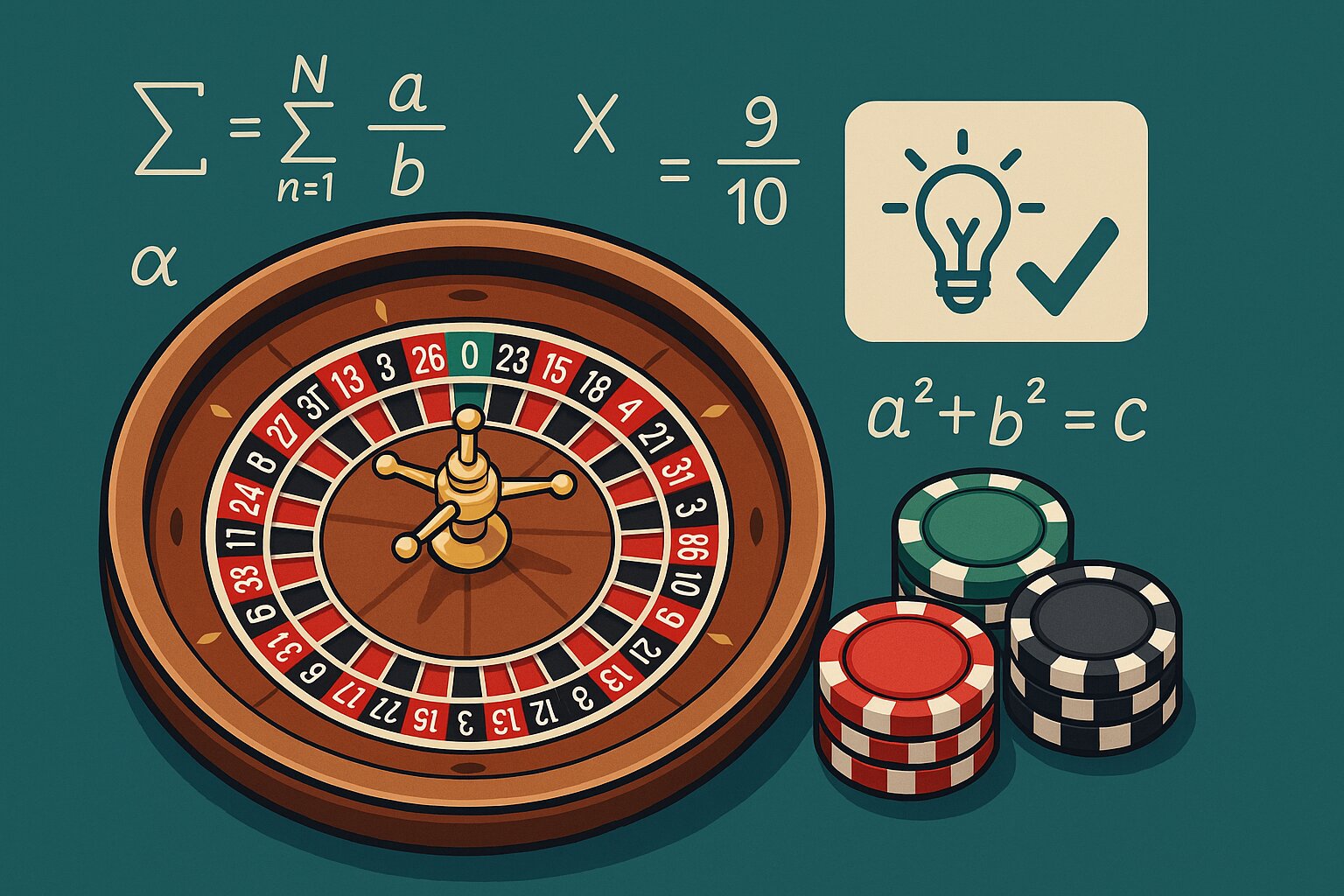
Are you curious about how roulette really works? Want to know the odds, the maths behind them and what the rules mean for your play? This guide walks through the essentials clearly and without myths.
We’re committed to giving you factual information so you can understand the game’s foundations and make informed choices. Read on for a plain explanation of the wheel, the bets, the probabilities and the practical implications for players.
What Are the Official Roulette Game Rules?
Roulette is a casino table game in which players place bets on where a small ball will land on a spinning wheel. The core play is straightforward: place your chips, the wheel and ball are set in motion, and the result is decided when the ball settles into a pocket.
Two main versions are commonly played. European roulette has 37 pockets numbered 0 to 36. American roulette adds a separate 00 pocket, making 38 pockets in total. That extra pocket changes the numerical probabilities and the long-term outcome for players.
Bets are placed on a marked layout that mirrors the wheel. You can cover individual numbers, number groups, colours, or broader categories such as columns and dozens. Each bet type has a defined payout, and once the dealer pays winners and clears losers, the next round begins. The rules are consistent and intended to make the game simple to follow whether you are at a physical table or playing online.
If you are new to the table, take a moment to learn the table layout and common bet names. Knowing where to place chips and what each bet covers helps avoid mistakes and makes the game easier to follow.
Understanding the Roulette Wheel and Table Layout
The wheel and the betting layout together determine how bets map to outcomes. On the wheel, numbers alternate between red and black, with the zero(s) shown in green. The order of numbers on the rim is not consecutive; it is arranged to balance the distribution of high and low, and red and black numbers.
The betting table is divided into two main areas: individual number squares and outside bets. Individual squares are for straight number bets, which have the highest payouts. Outside areas include even-money bets such as red or black, even or odd, and larger groups such as columns and dozens. These outside bets cover more numbers and therefore offer higher chances of winning but lower payouts.
Familiarity with both wheel and layout helps you see why certain bets carry particular odds and payouts. Once you recognise how groups on the table correspond to sectors on the wheel, you will better understand the relationship between bet size, coverage and potential return.
How Do Roulette Odds Work?
Odds in roulette come from comparing the number of winning pockets to the total pockets on the wheel. For a straight-up bet on a single number, probabilities are 1 in 37 on a European wheel and 1 in 38 on an American wheel. Those fractions explain why straight-up bets offer large payouts but only win rarely.
Bets that cover multiple numbers improve your chance of winning while reducing the payout. For example, a red or black bet covers 18 numbers. On a European wheel that gives 18 out of 37 possible outcomes. Dozen or column bets cover 12 numbers, so the chance there is 12 out of 37 on a European wheel. The payout structure balances the expected return with the probability of a win.
Because each bet type has fixed payouts, the maths of odds and payouts together determine the expected return for players. Understanding those ratios lets you compare the relative risk and reward of different bet types without relying on misconceptions.
The Role of Probability in Roulette Outcomes
Probability is the way we express the likelihood of each possible result. Every spin is independent: the outcome of one spin does not change the probabilities of the next. This independence is central to understanding why apparent short-term streaks do not alter the underlying odds.
Probability also explains variance. You might see several wins or losses in a short sequence because random variation produces clusters. Over a very large number of spins the results tend to align with the statistical expectations, but in the short term outcomes can diverge significantly from the averages.
This links directly to the concept of the house edge and how it affects play over time. If you want to consider longer-term expectations, the house edge gives a more useful picture than a few spins’ results.
House Edge Explained: What Does It Mean for Players?
The house edge is the percentage of all wagers that the casino expects to keep in the long run, and it stems from the wheel design and the payout schedule. European roulette’s single zero produces a house edge of about 2.7 percent. American roulette, with its extra 00, raises that edge to around 5.26 percent.
Put simply, the house edge tells you how the expected value of your wagers compares to the amounts you stake. It does not predict individual outcomes but indicates how the game favours the operator over many plays. Choosing which version to play and which bets to make can affect how quickly the house edge will influence your bankroll.
If you prefer a style of play where the house edge is lower, European roulette is typically the better choice. That difference matters most to players who play many spins rather than those who play just a few.
Does a Winning Formula for Roulette Exist?
Questions about a guaranteed winning method are common, but the design of roulette prevents any strategy from changing the fundamental probabilities. Since every spin is independent and the payouts are fixed relative to the number of covered outcomes, no betting pattern can alter the expected return.
Some players use betting systems intended to manage bankroll or bet sizes. These systems can change the distribution of wins and losses over a session, but they do not change the underlying odds or the house edge. In some cases, aggressive progression can expose players to larger losses or table limits that prevent the system from working as intended.
If you want to choose a betting approach, do so to suit your comfort with variance and bankroll, not with an expectation of overturning the game’s mathematics.
Common Myths About Roulette Systems
Popular myths include ideas that past results affect future spins, that certain numbers are “due” to appear, or that specific sequences guarantee success. None of these hold up because the mechanism producing results does not remember previous outcomes.
Systems named after sequences, such as the Martingale or Fibonacci, may sound mathematical, but their limits are practical: they rely on doubling or increasing stakes to recover losses. That can encounter table maximums or deplete a bankroll much faster than anticipated. Other claims about exploiting wheel bias relate to physical defects and are not relevant to modern equipment and regulated online software.
Understanding these myths helps set realistic expectations about what systems can and cannot do.
Responsible Gaming: Setting Limits and Expectations
Playing roulette should be accountable and planned. Before you begin, think about a budget and a time frame that suit you, and treat those as firm boundaries. Good practice is to separate entertainment spending from other finances and to stick to limits that do not affect your wider life.
Tools on many platforms let you set deposit, loss or session boundaries. These can be useful to prevent unintentional overspending. If play ever stops being enjoyable or you feel pressured to continue, pause and reassess. Free, confidential support services are available if you need them.
Keeping these measures in place helps you control your play without needing to rely on memory or willpower alone.
Roulette FAQs for UK Players
This section answers common practical questions and clarifies legal and technical points for players in the UK.
Can I Play Roulette Online Legally in the UK?
Yes, online roulette is available to anyone who meets the legal requirements and uses a suitably regulated operator. Regulated platforms must adhere to consumer protection and fairness standards.
What’s the Minimum Age to Play Roulette Online?
You must be at least 18 years old to play roulette online in the UK.
Is There a Way to Improve My Chances of Winning?
No strategy can change the game’s mathematics or the house edge. Some betting patterns may alter the short-term shape of wins and losses, but they do not improve the expected return. Choose play styles that match your bankroll and tolerance for variance.
What’s the Difference Between European and American Roulette?
European roulette features a single zero and generally offers a lower house edge. American roulette includes a 0 and a 00, increasing the house edge and reducing expected returns for the player over time.
Where Can I Get Help If I’m Worried About My Gambling?
Support organisations provide confidential advice and practical help. If you feel concerned about your gambling, consider contacting a recognised support service for guidance and options.
Thank you for reading. If you would like more detail on any part of the game, we can explore particular bet types, payout tables or how variance affects short sessions.
**The information provided in this blog is intended for educational purposes and should not be construed as betting advice or a guarantee of success. Always gamble responsibly.