
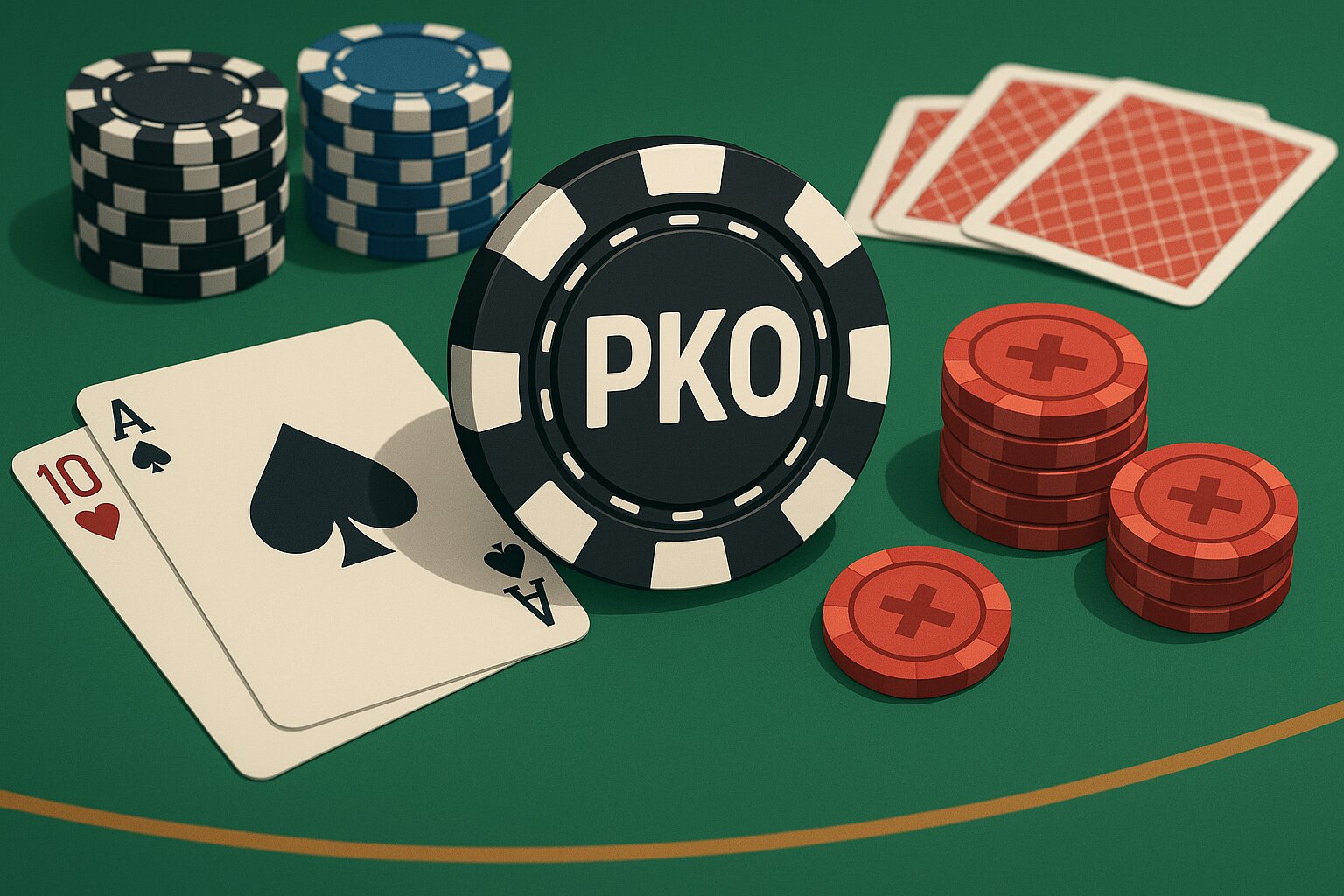
Progressive Knockout (PKO) Poker has become a popular choice for many online players because it layers an evolving bounty system on top of standard tournament play. The result is more cash-changing-hands during the event, which affects how players approach each decision.
With PKO Poker, knocking out an opponent pays an immediate cash reward, and a portion of that opponent’s bounty is added to your own. That shifting bounty creates fresh tactical choices at every stage of the tournament.
In this article we’ll explain how PKO tournaments work, compare them with fixed-bounty formats, dispel common myths, and cover the practical points players should understand before entering one. Keep reading to get a clear picture of what to expect and how the format changes the game.
How Does the Progressive Knockout Format Work?
In a PKO tournament, every entrant begins with a bounty attached to their stack. When a player is eliminated, part of their bounty is paid straight to the player who made the knockout; the remainder is added to the winner’s bounty. That means as you collect eliminations your own bounty grows, and other players start to target you more aggressively.
Alongside the bounty activity, the main prize pool functions as in any tournament: finishing positions determine the larger payouts at the end. The dual-reward structure—instant bounties plus final placings—introduces two overlapping objectives for players to balance. Do you pursue knockouts for immediate reward, or protect your stack to climb the places in the main payout ladder?
This format changes hand selection, position play and endgame tactics, since the evolving value on each head influences opponents’ willingness to gamble. Understanding how bounties accumulate helps you decide when to be assertive and when to preserve chips.
Differences Between PKO Poker and Traditional Knockout Tournaments
At first glance PKO and traditional knockout events may look similar, but their payout mechanics lead to different strategic environments.
In a conventional knockout tournament every player carries a fixed bounty that transfers in full to the eliminator. Those bounties do not change, so the incentive to target a player remains constant throughout the event.
PKO tournaments split each eliminated player’s bounty: an immediate payout plus an amount that increases the eliminator’s bounty. That progressive element alters incentives as the event unfolds—players with large bounties become focal points, and the distribution of aggression around the table shifts accordingly.
These structural differences affect pacing and risk-reward calculations. Players who master when to hunt bounties and when to prioritize chip accumulation will generally fare better than those who treat PKOs the same as fixed-bounty events.
If you want to try the format, consider playing lower-stakes PKOs first to get a feel for how bounties change behaviour at different stack sizes.
What Happens to the Bounty in PKO Poker?
Every bounty in a PKO starts at the tournament’s advertised amount. When an elimination occurs the bounty is divided: part is paid instantly to the player who knocked out the opponent, and the balance is credited to that player’s bounty, enlarging it for future eliminations.
Over time, specific players can accumulate substantial bounties by repeatedly eliminating opponents. That makes their stacks more attractive targets and can shift the table’s dynamics—other players may tighten or widen their calling ranges when facing a large-bounty opponent.
Because bounties grow with eliminations, you have to weigh the immediate value of a knockout against the future cost of becoming a target. This trade-off plays out continuously and is especially pronounced in later stages when fewer players remain and bounties are larger.
Common Myths About Progressive Knockout Poker
Several misconceptions about PKO tournaments persist, so it helps to separate fact from fiction.
One myth is that chasing bounties is always the path to the biggest returns. In truth, indiscriminate bounty hunting can deplete your chips and undermine your place in the main prize pool. Successful players balance pursuit with preservation.
Another idea is that only highly aggressive players succeed. While aggression is a tool in PKOs, selective aggression—based on stack sizes, position, and bounty values—tends to produce better results than a one-dimensional style.
Some think rising bounties guarantee profit. The progressive structure creates opportunity but not certainty; outcomes depend on decisions, position, the actions of others and variance inherent in the game.
Understanding these points clarifies what the format rewards: thoughtful, situational play rather than a single dominant approach.
Benefits of Playing PKO Poker
PKO tournaments introduce continuous engagement because money can be won at virtually any moment. That makes many hands more consequential and keeps attention focused on both short-term swings and long-term laddering.
The evolving bounties create fresh strategic puzzles: you must consider how an elimination changes incentives at the table and how your own bounty might alter opponents’ tactics later on. That complexity appeals to players who enjoy adjusting strategy rather than relying on a fixed template.
The format is adaptable to many styles. Whether you favour measured pressure or cautious accumulation, PKOs reward players who read the table and adapt as bounties shift. For variety-seeking players, they offer a different kind of competitive test compared with single-focus events.
If you’re tempted to play, start at modest buy-ins to build an intuitive sense of how bounty values and opponent behaviour interact.
Is PKO Poker Suitable for Beginners?
PKO tournaments are accessible to newcomers but do come with a learning curve because of the progressive bounty mechanic. New players benefit from taking time to understand how eliminations affect both immediate rewards and future targeting.
Lower-stakes PKOs and practice games provide a low-pressure environment to experience typical scenarios: when an opponent’s bounty makes them a likely shoving target, how to approach short-stack situations, and when preserving chips for a deep run is preferable to pursuing a single knockout.
It’s also wise to set personal limits on time and money before playing and to use whatever account tools are available to manage play. If concerns about behaviour arise, support and self-help resources are available from official help lines and support organisations.
Approaching PKOs as learning opportunities rather than quick routes to large returns will make them a more constructive and enjoyable part of your poker experience.
Key Terms to Know in Progressive Knockout Poker
Familiarity with a few terms will help you follow PKO action and interpret table dynamics quickly.
Bounty
A cash amount attached to each player that can be partially won when they are eliminated.
Progressive Bounty
The portion of an eliminated player’s bounty that is added to the eliminator’s bounty, increasing the value of their head during the tournament.
Main Prize Pool
The pot of prize money distributed according to finishing positions, separate from the bounties awarded during play.
Elimination
When a player loses all their chips and leaves the event, enabling the player responsible to collect the applicable bounty payout.
Buy-In
The entry fee for the tournament, typically split between the main prize pool and the initial bounty allocation.
Knowing these terms helps you understand why opponents act the way they do and how the tournament’s incentives shift. If anything here feels unclear, consult the site’s help pages or customer support before entering your first PKO.
If you’re ready to give PKOs a try, check the upcoming schedules on our site and consider starting at lower buy-ins to familiarise yourself with the mechanics and table flow. Good luck with your play, and enjoy the tactical challenge PKO tournaments provide.
**The information provided in this blog is intended for educational purposes and should not be construed as betting advice or a guarantee of success. Always gamble responsibly.